Choosing the right hardware can determine whether a glass door feels refined, secure, and dependable. For architects, installers, and property owners, the question is not simply, “what materials are best for glass door hardware?” The answer depends on door weight, traffic levels, moisture, cleaning routines, and the surrounding design.
In 2026, stainless steel remains a practical choice for hinges, handles, locks, and patch fittings. Its strength suits busy entrances, while its clean surface works well with modern interiors. However, not every stainless-steel product performs equally. Grade, manufacturing quality, surface finishing, and installation accuracy all matter. A poorly aligned hinge can damage the glass, even when the metal itself appears premium.
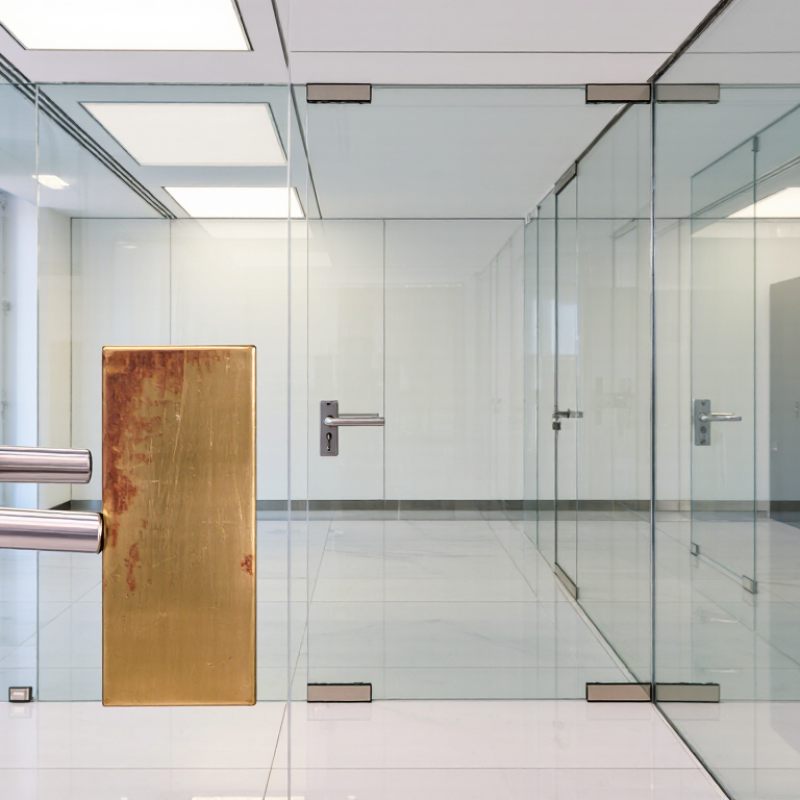
Brass offers warmth and character. It can make a frameless door feel more residential or luxurious. Yet, its finish may change over time, especially near water or harsh cleaning chemicals. Aluminum is lighter and often more economical, but it may not suit every heavy-duty application. Zinc alloys can provide attractive shapes, although long-term performance requires careful product evaluation.
Small details matter.
This guide compares common hardware materials through practical experience, technical performance, maintenance needs, and design value. It also considers lessons from real installations, where condensation, fingerprints, loose fasteners, and frequent impact reveal weaknesses quickly. Some recommendations remain conditional. A material that performs well in a dry hotel corridor may disappoint in a coastal bathroom. Reliable selection requires more than appearance; it requires honest attention to the door system, environment, and installer’s judgment.
Material selection now requires more than stainless-steel marketing claims. The 2016 NACE IMPACT study estimated global corrosion costs at US$2.5 trillion, or 3.4% of global GDP. That figure supports stricter testing for hinges, clamps, handles, and patch fittings. Austenitic stainless steel, brass, and protected aluminum remain practical options, but exposure decides the winner.
Specify ASTM B117 and ISO 9227 salt-spray testing in the purchase criteria. These methods expose samples to controlled salt fog, revealing pitting, staining, and coating failure. They do not predict exact outdoor service life. That limitation matters. Test hours should match the location, cleaning chemicals, humidity, and coastal exposure. Require photographs, chamber conditions, specimen preparation, and failure ratings with every report. A glossy finish can hide early corrosion.
Load testing must cover static weight and repeated operation. Measure deflection, fastener movement, glass contact, and post-test alignment. Include a safety factor for door mass, impact, and installation variation.
Finish tests should include coating adhesion, thickness, color change, and resistance to cleaners; ASTM D3359 and ASTM D7091 can support these checks where applicable.
ISO 9227 itself warns that salt spray is comparative, not a universal service-life prediction. A stronger specification combines laboratory evidence with site experience. That is less convenient, but more honest.
Glass door hardware faces moisture, fingerprints, cleaning chemicals, and daily mechanical stress. The stainless steel grade matters, especially near coastlines, swimming pools, and salted walkways. Grade 304 performs well in many dry indoor areas. It offers good strength, appearance, and reasonable corrosion resistance.
Grade 316 contains about 2–3% molybdenum. That addition improves resistance to chloride attack and pitting. Chlorides can enter through sea air, pool water, sweat, or deicing salt. In these locations, 316 is usually the safer choice for hinges, handles, clamps, and brackets. It is not rust-proof. Poor drainage, trapped moisture, and damaged surfaces can still create staining.
Details matter. Field inspections often find corrosion inside narrow gaps, not across exposed surfaces. A smooth finish helps cleaning, while compatible screws reduce galvanic corrosion risks. Regular rinsing can also remove salt deposits before they concentrate. Still, choosing 316 for every project may waste budget without improving performance. I would assess exposure first, then compare lifecycle cost. Indoor office doors rarely need the same alloy as a seaside entrance. The decision is less perfect than a simple grade label. Ensure installers protect the finish during cutting and fitting. Small scratches can become larger maintenance problems.
In 2026, glass door hardware selection should examine both the base metal and its finish. AAMA 2605 primarily evaluates high-performance organic coatings, especially on aluminum extrusions and panels. It measures color retention, chalking, gloss loss, adhesion, and corrosion resistance. The metal alone does not meet AAMA 2605.
Aluminum is the clearest match for this standard. A properly prepared aluminum handle with an AAMA 2605-compliant coating can resist ultraviolet exposure and humid entryways. Look for coating thickness, pretreatment details, and documented weathering results. Anodized aluminum is different. It should not be described as AAMA 2605 unless testing supports that claim.
Brass and bronze offer reassuring weight and warm, architectural color. Their surfaces can age attractively, but untreated finishes may tarnish near salt air or frequent cleaning. A coated brass or bronze component needs evidence for the complete finish system, not only the coating powder. Ask how the substrate was cleaned, sealed, and tested. Small failures matter. A thin edge near the glass can expose the base metal first. I have seen attractive samples change noticeably around door pull edges after repeated contact. That result does not make brass or bronze unsuitable, but it challenges optimistic specifications. Also check galvanic compatibility, fastener materials, and drainage around the fitting. AAMA 2605 data can guide the finish decision, but it cannot replace real exposure testing for every hardware design.
What Materials Are Best for Glass Door Hardware in 2026?
Material choice should begin with measured adhesion, not appearance. ASTM D3359-23 rates coating adhesion from 0B to 5B, with 5B showing no visible coating removal. For powder-coated hardware, this cross-hatch tape test offers a practical screening tool. A 4B or 5B result is usually reassuring, but it is not a complete durability guarantee.
Powder coating remains useful for aluminum handles and hinges exposed to frequent contact. FGIA/AAMA 2605 performance criteria also require resistance testing beyond adhesion, including humidity, weathering, and chemical exposure. That matters near pools, kitchens, and coastal entrances. Small failures often begin around drilled holes. Test the finished hardware, not only flat panels. This detail is easy to miss.
Anodized aluminum is not an organic paint film, so ASTM D3359 may not fully represent its performance. Inspectors should request coating-weight, color-retention, and corrosion data from controlled laboratory reports. PVD finishes can provide a dense decorative surface, but adhesion depends heavily on substrate preparation and cleaning. A tape score alone may hide weak bonding between layers. Use microscopy, abrasion testing, and salt-spray results where appropriate. The 2024 architectural coatings literature repeatedly stresses multi-test evaluation, though field conditions remain less predictable. That is the uncomfortable part. A beautiful 5B sample can still fail at an unsealed edge.
Select PVD, anodized, or powder coatings using ASTM D3359 adhesion data
ASTM D3359 classifies coating adhesion from 5B to 0B after a cross-hatch or cross-cut test. The chart shows the maximum percentage of coating area removed for ratings 5B through 1B; lower removal indicates stronger adhesion. For glass door hardware, compare PVD, anodized, and powder-coated samples on the actual substrate and under the same preparation, curing, and test conditions. ASTM D3359 measures adhesion only and does not by itself determine corrosion, wear, or chemical resistance.
What Materials Are Best for Glass Door Hardware in 2026?
Match Hardware Materials to Door Mass, Environment, and Load Ratings
Hardware selection should begin with door mass, not appearance. National Glass Association guidance places glass weight near 2.5 kg per square metre per millimetre of thickness. A 12 mm panel therefore weighs about 30 kg per square metre, before hardware is added. Stainless steel hinges, patch fittings, and rails usually suit heavy panels because they resist deformation and repeated impact. Aluminum remains useful for lighter doors and interior applications, but thin profiles can flex under concentrated loads.
Environment changes the material decision. Coastal entrances need corrosion-resistant stainless steel, preferably with suitable molybdenum content for chloride exposure. Dry indoor spaces may tolerate plated steel, although damaged plating can expose weaker metal. ISO 12944 corrosion classifications show why humidity and salt exposure require different protection levels. The rating matters more than a polished finish.
Load ratings must be checked against the complete assembly. ANSI/BHMA A156.4 closer testing recognizes Grade 1 performance at roughly 2 million cycles, while lower grades receive fewer cycles. That difference becomes important on busy entrances. The closer, hinges, glass clamps, and frame must share compatible ratings. A stronger hinge cannot correct an under-rated clamp. Measure actual panel weight, width, frequency, and wind pressure.
There is a practical complication. Site conditions are often estimated. They should not be. Water, grit, misalignment, and poor installation can defeat excellent materials. A qualified installer should verify fastener type, edge clearances, and adjustment after fitting. Still, material choice remains a judgment call, not a finish-selection exercise.
| Hardware Material | Typical Hardware Uses | Recommended Door Mass Range* | Suitable Environment | Typical Strength and Load Characteristics | Best Selection Criteria | Key Limitations | Maintenance Guidance |
|---|---|---|---|---|---|---|---|
| 316 Stainless Steel | Patch fittings, hinges, handles, locks, clamps, and sliding-door components | Up to 100–150 kg per door, when the complete tested system is rated accordingly | Coastal locations, humid interiors, swimming-pool areas, commercial entrances, and exposed semi-outdoor applications | High tensile and corrosion resistance; molybdenum content improves resistance to chlorides compared with 304 stainless steel | Choose for salt exposure, frequent cleaning, high traffic, and long service life | More expensive than 304 stainless steel; surface staining can still occur in severe chloride or contaminated environments | Rinse salt deposits with clean water and dry regularly; avoid chlorine-based cleaners and contact with carbon-steel dust |
| 304 Stainless Steel | Interior hinges, handles, clamps, locks, and general architectural fittings | Up to 80–120 kg per door, subject to hinge, fixing, and glass-system certification | Dry interior areas, offices, hotels, retail spaces, and standard commercial interiors | Strong, durable, and widely used for architectural hardware; good general corrosion resistance | Choose for normal indoor service where chloride exposure is limited | Less resistant than 316 stainless steel to salt spray, pool chemicals, and coastal conditions | Clean with a neutral detergent and soft cloth; remove fingerprints and moisture to reduce tea-staining risk |
| Architectural Brass | Door handles, pull bars, escutcheons, decorative trims, and selected hinges | Typically up to 60–100 kg per door for properly engineered hardware assemblies | Interior residential, hospitality, retail, and decorative applications with controlled humidity | Good machinability, wear resistance, and visual appeal; suitable strength for many interior fittings | Choose when appearance, tactile quality, and finish options are important | Can tarnish or develop verdigris; some finishes may be affected by ammonia, acids, salt, or aggressive cleaners | Use pH-neutral cleaner; maintain lacquered or plated finishes according to the finish supplier’s care requirements |
| Anodized Aluminum | Sliding-door rails, top tracks, profiles, handles, frames, and lightweight accessory components | Typically up to 60–100 kg per sliding panel when the complete track system is rated for the load | Interior partitions, offices, retail spaces, and moderate-humidity applications | Lightweight with a useful strength-to-weight ratio; anodized surfaces provide improved wear and corrosion resistance | Choose when low hardware weight, smooth profile integration, and economical installation are priorities | Lower stiffness and surface hardness than steel; galvanic corrosion may occur when incorrectly paired with dissimilar metals | Keep tracks free of grit; clean with mild detergent and avoid abrasive pads that can damage the anodized layer |
| Zinc Alloy, Die-Cast | Interior handles, covers, trim plates, locks, and decorative fittings with moderate duty cycles | Typically up to 40–70 kg per door for non-critical interior hardware | Dry indoor residential and light-commercial environments | Good casting detail and cost efficiency; adequate for moderate loads when supported by a suitable internal mechanism | Choose for decorative shapes, economical interior hardware, and low-to-medium traffic | Lower impact and fatigue resistance than stainless steel; unsuitable for many high-load, coastal, or heavily abused applications | Prevent standing moisture and clean using a soft cloth; inspect plated finishes for blistering or wear |
| Engineering Polymer, Such as POM or Nylon | Guide rollers, spacers, bushings, soft-close parts, isolation washers, and protective inserts | Usually below 40–60 kg per door for primary moving components; higher values require product-specific testing | Interior applications where electrical isolation, low noise, and low friction are needed | Low friction, quiet operation, and good resistance to many common chemicals; useful for reducing glass-to-metal contact | Choose for wear surfaces, vibration control, corrosion isolation, and noise reduction rather than primary structural support | Creep, UV exposure, temperature, and chemical compatibility can reduce performance; not normally a substitute for structural metal fittings | Keep clean and inspect for deformation, cracking, hardening, or excessive wear; replace parts at the first sign of damage |
| EPDM or Silicone Elastomer | Gaskets, setting blocks, seals, bumpers, and anti-slip interfaces | Not a primary load-bearing material; supports and isolates glass within the rated hardware assembly | Bathrooms, humid interiors, façades, and applications requiring sealing or vibration isolation | Provides resilient contact, sealing, and stress distribution; EPDM generally performs well against weathering and water | Choose to prevent direct glass-to-metal contact and reduce point-impact risks | Incorrect hardness, thickness, or compression can affect glass support and door alignment; compatibility with sealants must be checked | Inspect for compression set, cracking, shrinkage, and loss of elasticity; replace when the seal no longer provides continuous contact |
Austenitic stainless steel, brass, bronze, and protected aluminum remain practical choices. Exposure conditions decide the better option.
Specify ASTM B117 or ISO 9227 testing. Check pitting, staining, coating failure, and visible edge corrosion.
No. Salt spray compares samples under controlled conditions. It cannot predict exact service life in every location.
Request chamber conditions, specimen preparation, photographs, exposure duration, and failure ratings. Missing details weaken the result.
Yes, when properly prepared and protected. Check pretreatment, coating thickness, ultraviolet results, and resistance to cleaning chemicals.
No. Untreated surfaces may tarnish near salt air or frequent cleaning. Warm color can change around pull edges.
Test static weight and repeated operation. Measure deflection, fastener movement, glass contact, and final door alignment.
Ask for adhesion, thickness, color change, gloss loss, and cleaner resistance. ASTM D3359 and ASTM D7091 may support these checks.
Check galvanic compatibility, fastener materials, drainage, and narrow edges near the glass. Small failures can appear early.
Combine laboratory testing with site experience. A polished sample may still perform poorly after installation. That possibility deserves attention.
Choosing what materials are best for glass door hardware in 2026 requires more than comparing appearance and price. The evaluation should begin with durability benchmarks, including salt-spray testing under ASTM B117 or ISO 9227, load capacity, corrosion resistance, and finish performance. Stainless steel remains a strong choice, with 304 suitable for many indoor and moderate environments, while 316 offers improved chloride resistance because it contains approximately 2–3% molybdenum. Brass, bronze, and aluminum can also perform well when their finishes meet demanding AAMA 2605 expectations.
Surface protection is equally important. PVD, anodized, and powder-coated finishes should be selected using verified adhesion results, such as ASTM D3359 data, along with resistance to wear, moisture, and chemicals. Ultimately, the best material depends on the glass door’s mass, usage frequency, surrounding environment, and required load rating. A properly matched combination of base material, finish, and tested hardware design will provide safer operation, longer service life, and consistent appearance.
Nova Glass Door